Published By: Rutul Patel (B.Pharm, MBA) | Published On: 12 April 2026 | Read Time: 9 Minutes
Hello Readers!
Welcome back to your weekly update on what's happening in the Indian pharmaceutical industry.
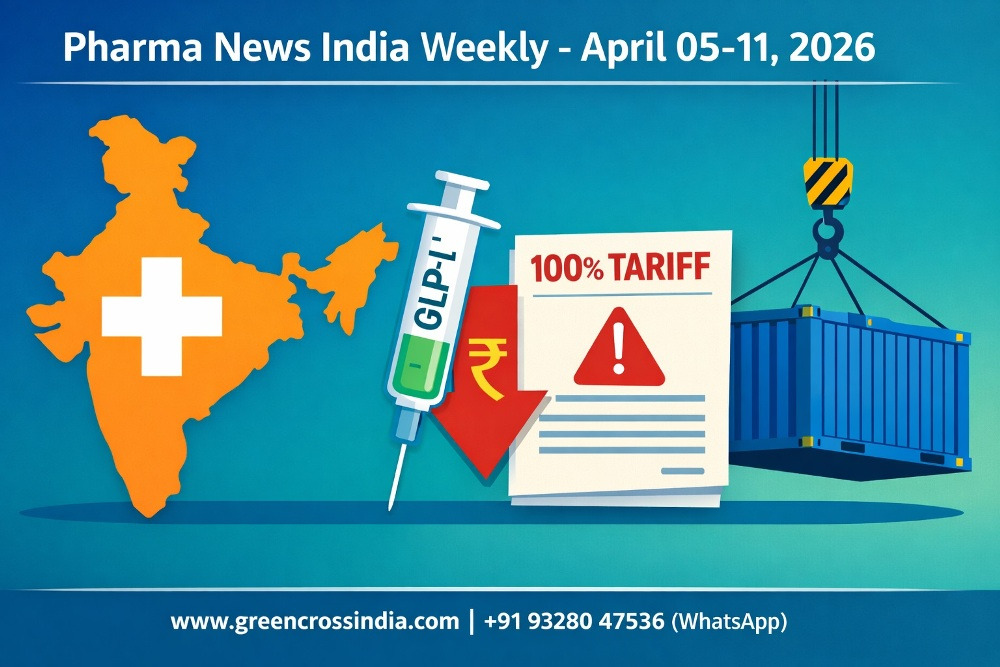
The week of April 5 to April 11, 2026, was full of action. A massive price war in weight-loss drugs. Whispers of a $12 billion acquisition. The government jumping in to fix supply chains.
Lots to cover. So let's get started.
Quick Look: Top Stories This Week
Before we dive deep, here's what happened:
One. Eli Lilly's Mounjaro lost market share to generic semaglutide.
Two. Sun Pharma is reportedly eyeing a $12 billion deal for US-based Organon.
Three. Government increased LPG allocation for pharma to 70%.
Four. Aurobindo announced an ₹800 crore share buyback.
Five. Cancer drug makers asked for a 50% price hike.
Six. AstraZeneca plans to sell its Bengaluru facility for ₹3,400 crore.
Seven. Vaccine testing is moving to government labs only.
Eight. Biocon wants to become the world's insulin leader.
Now let me explain each one in simple terms.
1. GLP-1 Market Shakeup: Generics Hit Eli Lilly Hard
You remember the semaglutide patent expiry last month? Well, the impact is now visible in sales numbers.
Mounjaro sales dropped sharply.
According to Pharmarack data, Eli Lilly's Mounjaro sales fell to ₹114 crore in March 2026. That's down from ₹135 crore in February. A 15% drop in just one month.
Meanwhile, generic semaglutide versions are selling like hot cakes. Their sales jumped 23% to ₹59 crore.
Here's what happened.
Within days of the patent expiry on March 20, nearly 13 Indian companies launched 26 different generic versions. More are on the way.
Let me share the market share picture:
Mounjaro's share fell from 71% in February to 64% in March.
Semaglutide's share rose from 25% to 33%.
Eli Lilly's value share dropped from 61% to 56%.
The GLP-1 market in India is now worth about ₹1,600 crore.
Which Indian company is winning?
Torrent Pharmaceuticals has emerged as the top generic semaglutide player after Novo Nordisk. They hold 8% market share.
Other players include Sun Pharma (Noveltreat, Sematrinity), Dr. Reddy's (Obeda), Zydus, Lupin, and Glenmark (Glipiq).
Sheetal Sapale from Pharmarack said it perfectly: "Participation is high, but value capture will be concentrated among top three to four players."
What about Novo Nordisk?
They didn't sit quietly. The company slashed Wegovy prices by 48% and Ozempic by 36%. Their starting dose now costs ₹5,660 per month – very close to generic prices.
Smart strategy. Keep prices competitive and rely on brand trust.
2. Sun Pharma-Organon: A $12 Billion Mega Deal?
Now this is interesting.
Reports surfaced this week that Sun Pharmaceutical Industries is in advanced talks to acquire Organon – a US-based women's health company spun off from Merck.
The deal value? About $12 billion. That would be Sun's largest acquisition ever.
But wait.
Sun Pharma quickly issued a statement to stock exchanges. They called the reports "speculative in nature" and said there was "no material event or information requiring disclosure."
Fair enough. But here's why people are still talking.
Sun Pharma Chairman Dilip Shanghvi had previously told investors the company was looking for "disciplined" acquisitions. And Sun has about $3.2 billion (₹26,000 crore) of net cash on its balance sheet.
Why would Organon make sense?
Three reasons.
First, Organon focuses on women's health – a growing segment.
Second, it has a biosimilar portfolio that could boost Sun's innovation pipeline.
Third, it would give Sun immediate scale in the US market.
The catch? Organon carries about $8 billion in debt. That's a heavy load to take on.
Following the news, Sun Pharma's shares closed down nearly 4% at ₹1,654.70 on BSE. Investors seem cautious – and honestly, that's understandable.
I'll keep you updated as this develops.
3. Government Secures Pharma Supply Chains
The West Asia conflict is still causing problems for drug manufacturers. But this week, the government stepped in with help.
First big move: LPG allocation increased to 70%.
The Ministry of Petroleum and Natural Gas raised LPG allocation for industrial units in pharmaceuticals, food, polymers, agriculture, packaging, ceramics, and glass. There's a cap of 200 tonnes per day per sector.
Why does this matter? Many drug manufacturing processes depend on LPG. Without it, production stops.
The government also said industries using LPG for specialized purposes don't have to switch to PNG. Practical move.
Second big move: Customs duty exemption continues.
The government removed customs duty on 40 petrochemical products through an April 1 notification. This covers critical inputs like propylene, ammonia, methanol, phenol, and isopropyl alcohol.
Third: Domestic refiners stepped up.
Bharat Petroleum and others have reconfigured production lines to supply specialized feedstock to pharma companies. Propylene – the most critical feedstock – is now being supplied locally for medicines like Ibuprofen.
But here's the reality.
Despite these measures, industry experts warn that supply chains will take months to fully stabilize. Pharmexcil Chairman Namit Joshi said it will take "at least a month or two to bring raw material prices back to normal."
The West Asia region accounts for 5-6% of India's total pharmaceutical exports. Any prolonged disruption will hurt.
4. Cancer Drug Makers Seek 50% Price Hike
This one hits close to home.
Manufacturers of platinum-based cancer drugs have approached the National Pharmaceutical Pricing Authority (NPPA) seeking a 50% increase in ceiling prices.
Why? Platinum prices have nearly doubled in the last six months.
Let me give you the numbers. Platinum cost ₹3,869 per gram in September 2025. By February 2026, it had shot up to about ₹8,000 per gram.
Which drugs are affected?
Carboplatin, oxaliplatin, and cisplatin. These are backbone treatments for multiple cancers including head and neck, breast, and gastrointestinal cancers.
The current ceiling price for carboplatin is just ₹61.10 per 10mg/ml vial. For cisplatin, it ranges from ₹70 to ₹300 based on strength.
Top manufacturers include Cipla, Intas, Dr. Reddy's, Zydus, Emcure, Fresenius, and Hetero. They say manufacturing has become commercially unviable at current prices.
Here's the problem.
Dr. Pramod Kumar Julka from Max Oncology called these "among the most affordable and widely accessible chemotherapy agents available."
Their low price is exactly what makes them good for patients. But that same low price now threatens their availability.
One industry executive put it bluntly: "Manufacturers have little financial incentive to produce them reliably."
These drugs have been under price control since 2013. For carboplatin, the price increase since 2015 is just 21.71% – that's only 2.21% compounded annually.
The Niti Aayog had endorsed a one-time 50% increase for essential medicines facing manufacturing issues back in 2019. Let's see if the government acts this time.
5. Aurobindo Pharma Announces ₹800 Crore Share Buyback
Good news for Aurobindo Pharma shareholders.
The company fixed April 12, 2026 as the record date for its ₹800 crore share buyback.
Key details:
Buyback price: ₹1,475 per share.
Number of shares: Up to 54.23 lakh equity shares (0.93% of paid-up capital).
Method: Tender offer route on proportionate basis.
Eligibility: All shareholders including promoters.
Why now?
Aurobindo's stock has shown real strength. It gained nearly 9% in a month while the ET Pharma Index fell 4.3% during the same period.
The company's Europe business is doing well – revenue share improved to over 31% in the December quarter. The US business is also expected to pick up.
Motilal Oswal expects Aurobindo to deliver 21% earnings growth annually over FY26-28. They've maintained a Buy rating with a target price of ₹1,500.
6. AstraZeneca to Sell Bengaluru Facility for ₹3,400 Crore
Big real estate move in pharma this week.
AstraZeneca Pharma India is planning to sell its 64-acre manufacturing facility in North Bengaluru.
The numbers:
Expected value: About ₹3,400 crore. That's over ₹53 crore per acre – shows how much Bengaluru land prices have risen.
Interested buyers include Sattva Group, Aurobindo Pharma, and RMZ.
Background:
The Bengaluru facility is one of nine global sites of AstraZeneca. It focuses on clinical trial design, safety monitoring, and regulatory compliance. The company was established in India back in 1979.
Why sell now?
The company wants to exit with scope for commercial and residential development. It's part of a broader trend – many companies are selling non-core land assets as property values rise.
This isn't unique to AstraZeneca. Players like Godrej Properties and Prestige Group have been actively buying such parcels.
7. Government to Restrict Vaccine Testing to Government Labs
Big regulatory shift here.
The Central Drugs Standard Control Organisation (CDSCO) plans to restrict testing of vaccines and biological products exclusively to government-controlled laboratories.
Why?
A government official explained: "The specialized nature of vaccines warrants a more restrictive testing environment."
The move aims to bring uniformity across all testing platforms.
Current setup:
India has 7 Central Drug Testing Laboratories and 36 state drug testing laboratories.
The private sector has 350-400 standalone labs approved for drug testing. But only a small fraction have the high-level biosafety certification required for vaccines.
Who will be affected?
Major vaccine manufacturers including Serum Institute of India (world's largest by doses), Bharat Biotech, Biological E, and Zydus Lifesciences.
However, Dr. Vikram Paradkar from Biological E noted that every single batch of their vaccines is already tested at their own facilities and submitted to the National Control Laboratory at Kasauli. "Thus, there is no change to existing practice," he said.
Context matters.
In FY25, 3,104 drug samples were declared Not of Standard Quality, and 245 were found to be spurious.
8. Biocon Aims for Global Insulin Leadership
Kiran Mazumdar-Shaw made a bold statement this week. Biocon aims to be "the" insulin company of the world.
Why now?
Global pharmaceutical giants are shifting focus toward high-margin GLP-1 therapies. They're moving away from insulin. Biocon sees this as a golden opportunity.
She put it bluntly: "Big insulin companies do not want to make insulin in cartridges or pens anymore. They are switching to selling insulin in vials, as they wish to focus on the GLP-1 opportunity."
Where does Biocon stand today?
Let me share some impressive numbers:
Third-largest supplier of both rh-Insulin and Insulin Glargine worldwide.
Only company in the world with two interchangeable insulins.
Over 9.2 billion doses of insulin provided worldwide.
Approvals across 80 countries.
The target?
Shreehas Tambe, CEO and MD of Biocon, said: "Our aim is to achieve 20% market share in the global insulin market."
The company is expanding insulin capabilities and has identified 20 emerging markets as growth markets. Biocon already reaches one in five insulin-dependent patients in the US.
On a related note...
Mazumdar-Shaw also called for a rethink of India's IPO framework. She argued that current norms requiring three years of revenue track record don't work for clinical-stage biotech companies.
"In the US, you can do all this. In India, Sebi requires three years of revenue track-record. How does a clinical-stage biotech ever meet that?" she asked.
Fair point.
9. Other Important News (Quick Bites)
Let me run through some other stories quickly.
Granules India is increasing oversight at its manufacturing facilities after the USFDA flagged violations in GMP, equipment cleaning, and contamination controls at its Telangana plant.
Natco Pharma is showing signs of a technical breakout. Analysts expect the stock to break above ₹1,050, with a medium-term target of ₹1,600.
Pharma exports touched $28.29 billion during April-February FY26, registering 5.6% growth. The sector is currently valued at $60 billion and projected to reach $130 billion by 2030.
A fake medicine racket was busted in Delhi. Six people were arrested, and over 1.20 lakh counterfeit tablets were recovered. The fake drugs included versions of Telma-AM, Ursocol-300, and Montair-LC. Stay careful, folks.
What This Means for You
Let me break it down.
If you're a patient: The GLP-1 price war is good news. Weight-loss and diabetes drugs are becoming more affordable. But please – only take these under proper medical supervision. They have side effects.
If you're an investor: The pharma sector remains a defensive bet. But stock picking will matter more than sector allocation. Do your homework.
If you're a regular medicine user: Be aware that cancer drug prices might go up. And supply chain disruptions could affect availability of some medicines in the short term. But the government is actively working on it.
FAQ
Q: What are the top pharmaceutical trends for 2026?
A: Based on this week's news: GLP-1 market disruption with generics capturing share from innovators. Consolidation through M&A like Sun Pharma-Organon. Supply chain localization amid geopolitical tensions. Biosimilar and insulin expansion. Regulatory tightening on vaccine testing. And price pressures on essential cancer drugs.
Q: What are the latest pharma news updates this week (05-11 April 2026)?
A: Quick recap: Eli Lilly's Mounjaro lost market share to generic semaglutide. Sun Pharma reportedly in talks to buy Organon for $12 billion. Government increased LPG allocation to 70% for pharma. Cancer drug makers seeking 50% price hike. Aurobindo announced ₹800 crore buyback.
Q: Where can I find all weekly pharma industry news?
A: For comprehensive weekly updates covering policy changes, market trends, and company-specific news, keep visiting Alboompro for my weekly pharma roundup.
Q: What is happening in the pharmaceutical industry this week?
A: The industry is navigating multiple challenges at once. A price war in the GLP-1 segment – good for patients, tough for innovators. Supply chain disruptions from the West Asia conflict. Potential mega-deal activity with Sun Pharma-Organon. And regulatory changes affecting vaccine testing.
Weekly Summary: Key Points
Let me leave you with the most important takeaways.
First, the GLP-1 market is being reshaped fast. Generic semaglutide captured 33% of the market within weeks. Mounjaro's share dropped to 64%.
Second, Sun Pharma is reportedly in advanced talks to acquire Organon for $12 billion. If it happens, it would be the company's largest deal ever.
Third, the government stepped up with practical relief. LPG allocation for pharma increased to 70%. Customs duty exemptions on 40 petrochemical products continue.
Fourth, cancer drug manufacturers are in trouble. Platinum prices have nearly doubled. They're seeking a 50% price hike.
Fifth, vaccine testing is moving exclusively to government labs.
Sixth, Biocon is making a bold play for global insulin leadership – targeting 20% of the global insulin market.
That's all for this week.
Found this useful? Share it with a colleague or friend who follows the pharma industry.
Got questions? Drop a comment below.
For more updates, keep visiting Alboompro.
See you next week!
– Rutul Patel (B.Pharm, MBA)
Disclaimer: This weekly news roundup is compiled from various publicly available sources including news publications, industry reports, and regulatory announcements. The information provided is for informational and educational purposes only and does not constitute medical advice, investment advice, or any professional recommendation. Readers are advised to consult qualified medical professionals before making any healthcare decisions and to conduct their own research before making any investment decisions.